
Through a Glass, Darkly
The Procession of the Holy Spirit from the Father and the Son

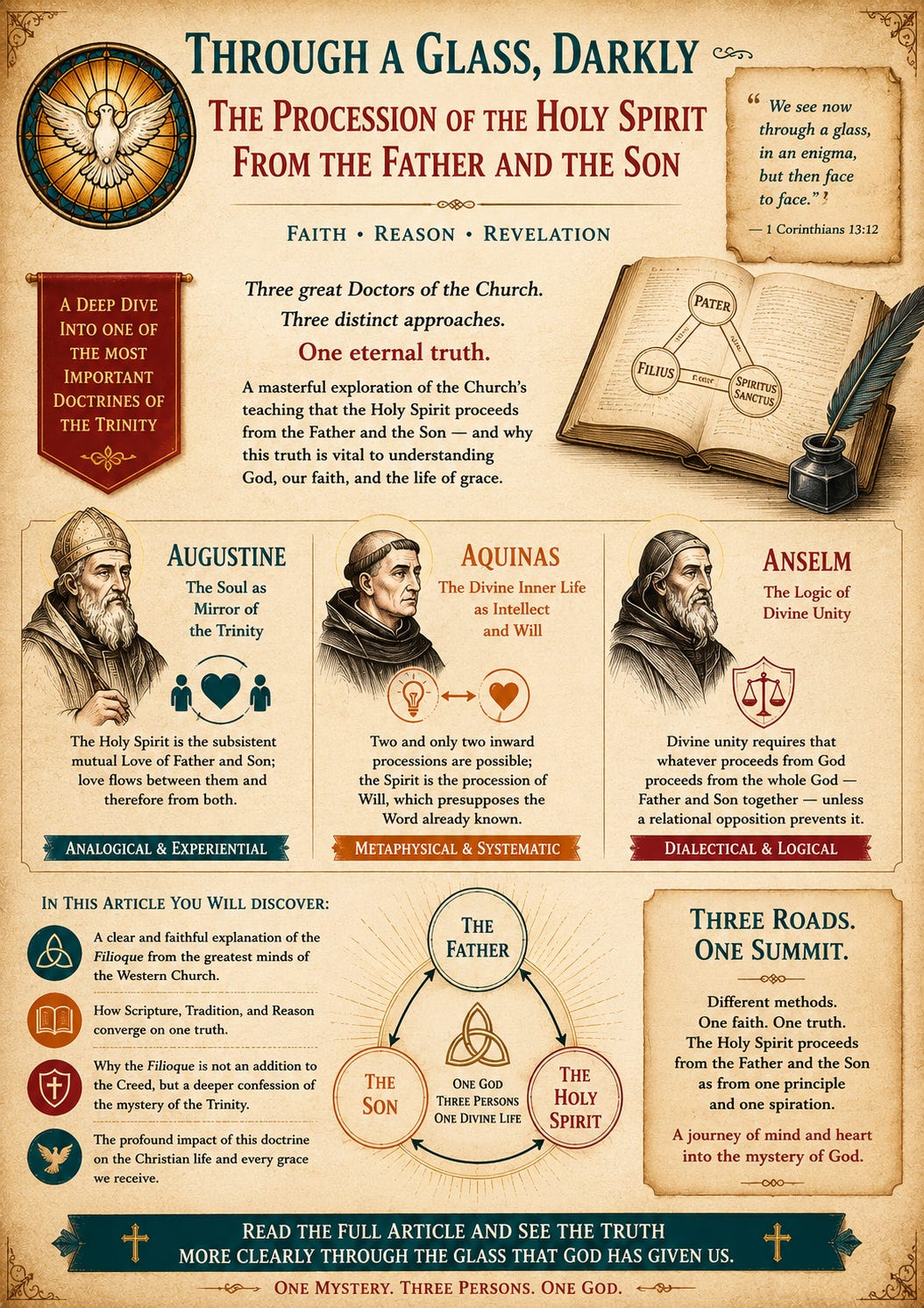
“We see now through a glass, in an enigma, but then face to face.”
— 1 Corinthians 13:12
Slide presentation of: Through a Glass, Darkly
I. The Glass and What It Shows
Saint Augustine, nearing the end of his monumental De Trinitate, pauses to offer a word of measured honesty. For fourteen books he has been leading the reader upward through the visible creation, through the structures of human psychology, toward some glimpse of the inner life of God. Now he writes of the Trinity: we see It now “through a glass, in an enigma” — and not yet face to face. He is not apologizing. He is orienting. The glass is real. What it shows is real. But it is not yet the Beatific Vision.
This is the right place to begin any serious reflection on the Filioque— the Western Church’s profession that the Holy Spirit proceeds from the Father and the Son. Few doctrines touch more deeply on the mystery of the Holy Trinity, and few have generated more sustained theological controversy. The Eastern churches, since the Great Schism, have rejected the Filioque as an illicit addition to the Creed and a distortion of Trinitarian doctrine. The Catholic Church has defined it as a dogma of divine faith, declared with particular solemnity at the Fourth Lateran Council (1215), the Second Council of Lyons (1274), and the Council of Florence (1439), which states:
“The Holy Spirit is eternally from the Father and the Son and has His essence and His subsistent being both from the Father and the Son, and proceeds from both eternally as from one principle and one spiration 1 .”
How are we to understand this doctrine — not merely to defend it, but to see into it, however partially, through the glass that God has provided?
Three great Doctors of the West offer three distinct but converging approaches:
Augustine through the mirror of the human soul;
Aquinas through the metaphysics of intellect and will; and
Anselm through the strict logic of divine unity.
Together, they illuminate the same truth from different angles. And throughout, Augustine’s “glass and enigma” remains our honest charter: we know something real, but not yet face to face.
II. The Question and Its Stakes
The word Filioque is simply Latin for “and from the Son.” When inserted into the Nicene Creed, it transforms “the Holy Spirit… who proceeds from the Father” into “the Holy Spirit… who proceeds from the Father and the Son.” The addition appears in the West as early as the Third Council of Toledo (589) and was gradually universalized in the Latin liturgy.
The doctrine touches the very interior life of God — the eternal relationships between the three divine Persons as they exist in themselves, prior to all creation. The Eastern position, called monopatrism, holds that the Father alone is the eternal unoriginate source of both the Son and the Spirit. The Catholic position holds that while the Father is indeed the unoriginate principle, the Holy Spirit proceeds from the Father and the Son as from a single principle and a single spiration — the Son having received this property from the Father by an eternal generation that precedes no time and diminishes no equality.
The pastoral stakes are equally serious. As the theologian Dennis Ngien observes, the Filioque binds the Holy Spirit to Jesus Christ in the life of the believer. The Spirit we receive in Baptism is the Spirit of Christ — not merely dispatched by Him in some external arrangement, but proceeding from His divine Person eternally. To sever that eternal bond, even in doctrine, is to alter the character of every grace the Spirit brings.2
III. The Scriptural Foundation
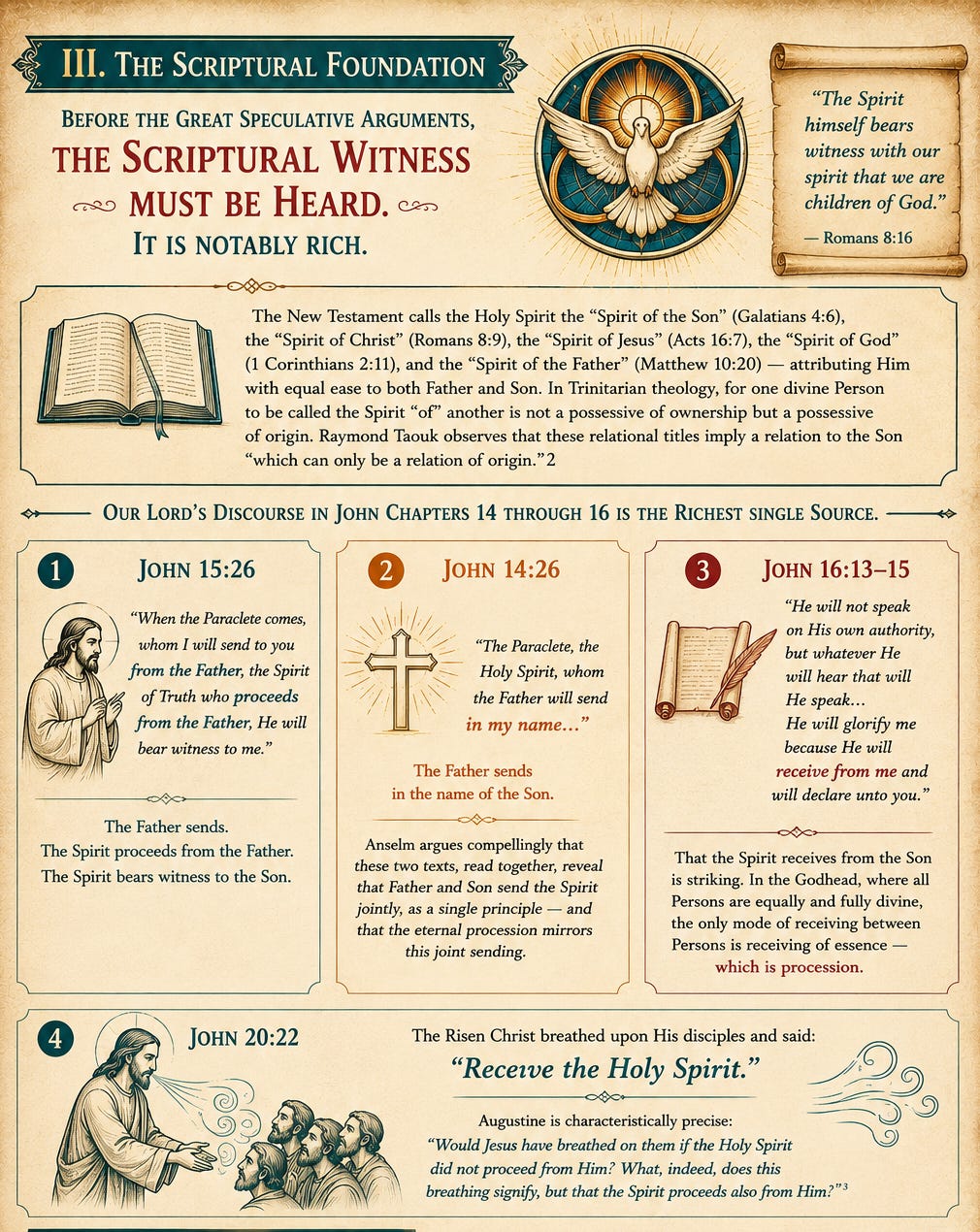
Before the great speculative arguments, the scriptural witness must be heard. It is notably rich.
The New Testament calls the Holy Spirit the “Spirit of the Son” (Galatians 4:6), the “Spirit of Christ” (Romans 8:9), the “Spirit of Jesus” (Acts 16:7), the “Spirit of God” (1 Corinthians 2:11), and the “Spirit of the Father” (Matthew 10:20) —> attributing Him with equal ease to both Father and Son. In Trinitarian theology, for one divine Person to be called the Spirit “of” another is not a possessive of ownership but a possessive of origin.
Raymond Taouk observes that these relational titles imply a relation to the Son “which can only be a relation of origin.”3
Our Lord’s discourse in John chapters 14 through 16 is the richest single source.
At John 15:26 He says: “When the Paraclete comes, whom I will send to you from the Father, the Spirit of Truth who proceeds from the Father, He will bear witness to me.”
At John 14:26: “The Paraclete, the Holy Spirit, whom the Father will send in my name…” Anselm, as we shall see, argues compellingly that these two texts, read together, reveal that Father and Son send the Spirit jointly, as a single principle — and that the eternal procession mirrors this joint sending.
At John 16:13–15 Our Lord says of the Spirit: “He will not speak on His own authority, but whatever He will hear that will He speak… He will glorify me because He will receive from me and will declare unto you.”
That the Spirit receives from the Son is striking. In the Godhead, where all Persons are equally and fully divine, the only mode of receiving between Persons is receiving of essence — which is procession.
Finally, John 20:22 records the Risen Christ breathing upon His disciples and saying: “Receive the Holy Spirit.” Augustine is characteristically precise: “Would Jesus have breathed on them if the Holy Spirit did not proceed from Him? What, indeed, does this breathing signify, but that the Spirit proceeds also from Him?”4
IV. Augustine: The Trinity in the Mirror of the Soul
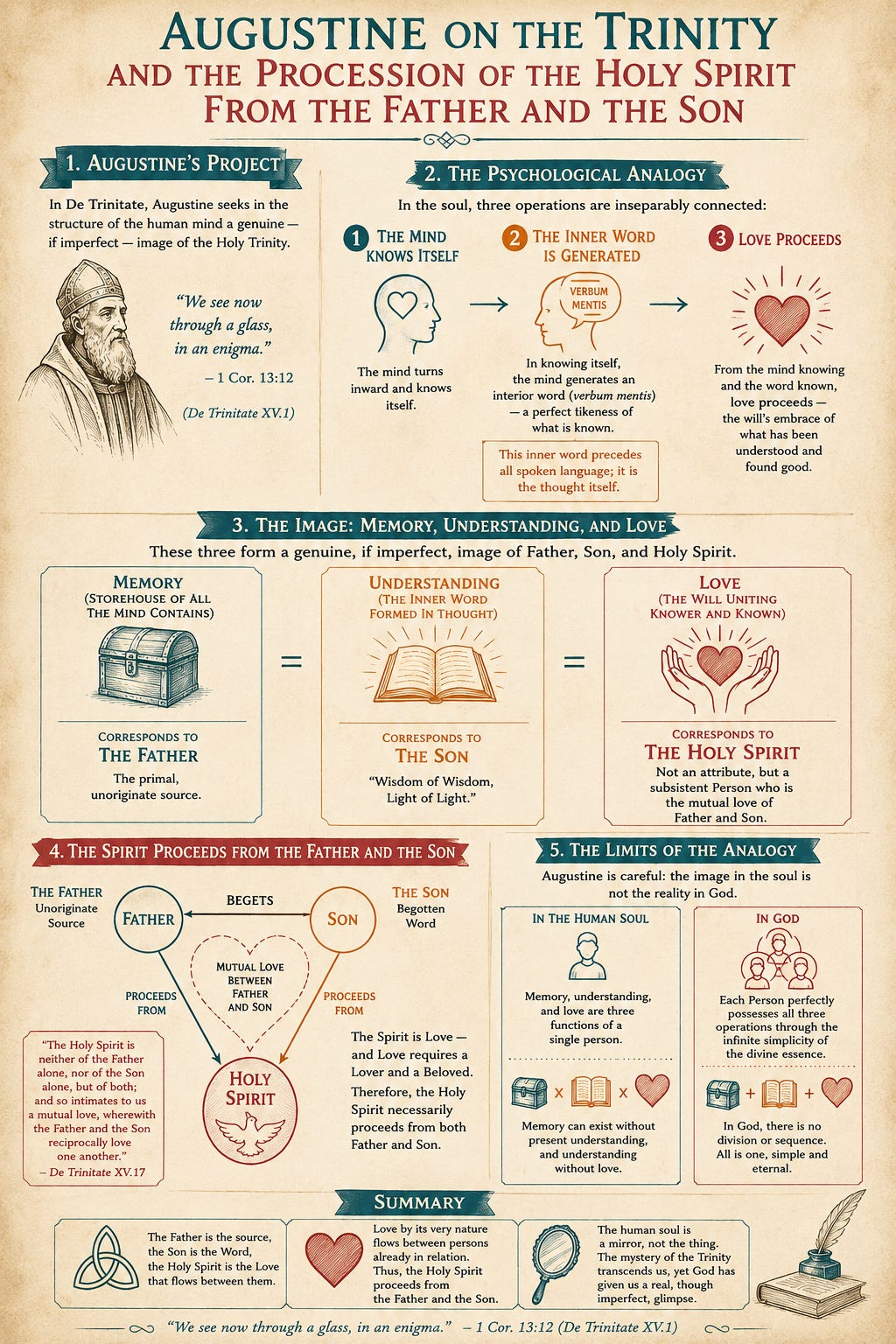
Augustine’s approach to the Filioque is inseparable from his great project in De Trinitate: to find, in the structure of the human mind, a genuine — if imperfect — image of the Holy Trinity. The famous “psychological analogy” unfolds as follows: the mind knows itself and in so doing generates an interior word (verbum mentis) — a perfect likeness of what is known. This interior word precedes all spoken language; it is the thought itself, formed in the act of understanding. And from the mind knowing and the word known, love proceeds — the will’s embrace of what has been understood and found good.
These three — memory (as the storehouse of all the mind contains), understanding (the inner word formed in thought), and love (the will uniting knower and known) — form a genuine, if imperfect, image of Father, Son, and Holy Spirit.
The Father corresponds to the memory: the primal, unoriginate source.
The Son corresponds to the inner word begotten by self-knowledge: “Wisdom of Wisdom, Light of Light5
The Holy Spirit corresponds to Love — not an attribute, but a subsistent Person who is the mutual love of Father and Son.
This is Augustine’s pivotal contribution to the Filioque. If the Holy Spirit is Love in the Trinity — if He subsists as the Love that flows between Father and Son — then He necessarily proceeds from both, for love by its very nature flows between persons already in relation.
Augustine writes in Book XV:
“The Holy Spirit is neither of the Father alone, nor of the Son alone, but of both; and so intimates to us a mutual love, wherewith the Father and the Son reciprocally love one another.”6
The Spirit is Love — and Love requires a Lover and a Beloved.
Yet Augustine is scrupulously honest about the imperfection of this mirror. In the human soul, memory, understanding, and love are three functions of a single person — not three persons of a single nature. In us, memory can exist without present understanding, and understanding without love. In God, each Person perfectly possesses all three operations through the infinite simplicity of the divine essence. The mirror is genuine; it is not the thing itself.
“We see now through a glass, in an enigma.”
V. Aquinas: The Two Processions of the Divine Life
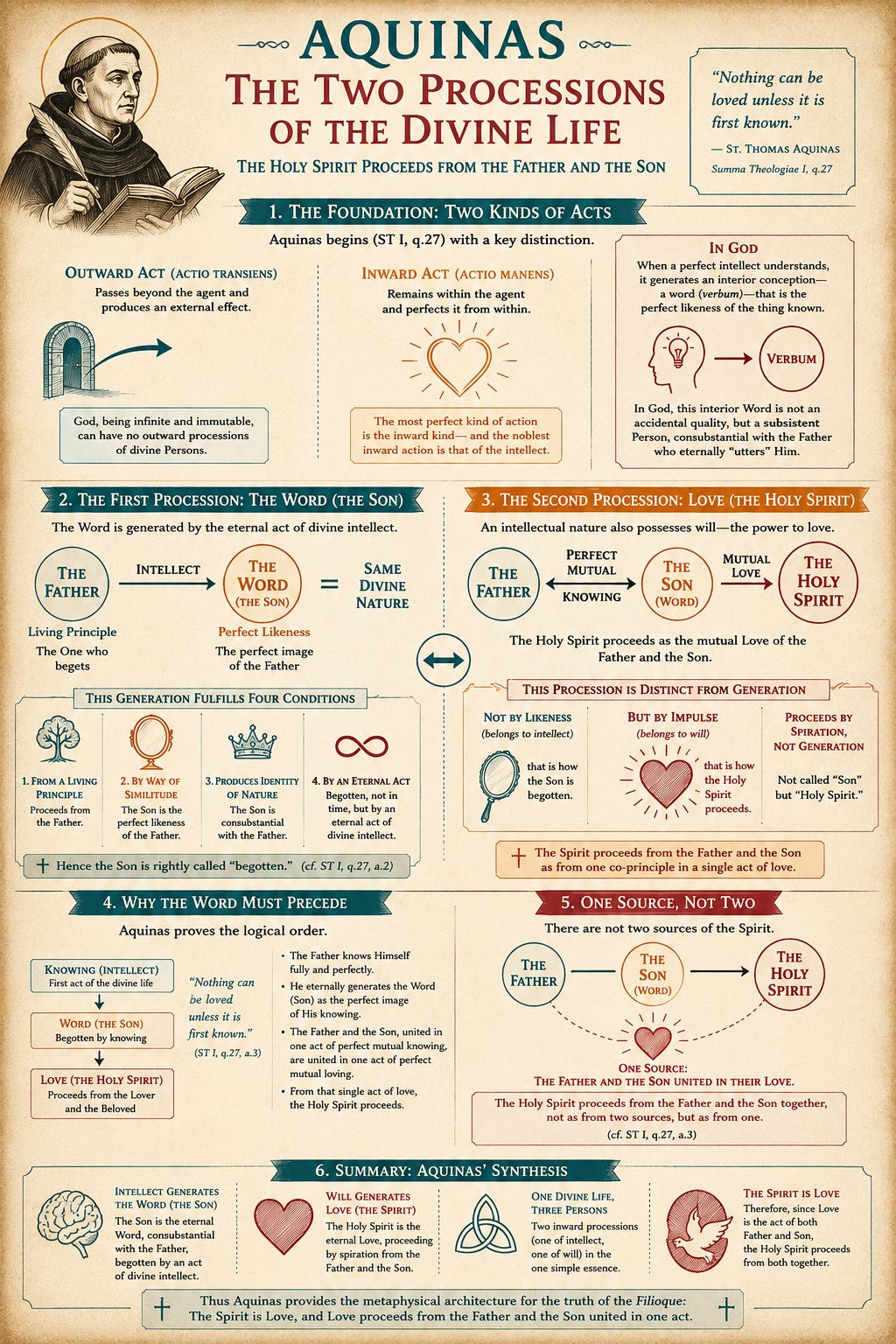
Where Augustine proceeds analogically, Aquinas proceeds metaphysically. His treatment in Summa Theologiae I, Question 27, begins with a foundational distinction: the difference between an outward act (actio transiens) — which passes beyond the agent and produces an external effect — and an inward act (actio manens) — which remains within the agent and perfects it from within. God, being infinite and immutable, can have no outward processions of divine Persons. But the most perfect kind of action is precisely the inward kind — and the noblest inward action is that of the intellect.
When a perfect intellect understands, it generates an interior conception — a word (Latin: verbum) — that is the perfect likeness of the thing known. In God, this interior Word is not an accidental quality (as human concepts are accidents of finite minds), but a subsistent Person, consubstantial with the Father who eternally “utters” Him.
This procession of the Word fulfills all four conditions of true generation:
It proceeds from a living principle (the Father),
By way of similitude (the Son is the perfect image of the Father),
And produces identity of nature (the Son is consubstantial with the Father). Hence the Son is rightly called “begotten” — generated by an eternal act of divine intellect.7
But an intellectual nature is not exhausted by intellect alone. It also possesses will— the power to love. Love, too, can be an inward act:
A Person proceeding from Father and Son as their mutual love.
This second procession is distinct from generation precisely because it proceeds not by way of likeness (which characterizes intellect) but by way of impulse — the vital movement of love toward its object.
Hence the Spirit is not “begotten” but proceeds by spiration, and is not called “Son” but “Holy Spirit.”
Crucially, Aquinas demonstrates that the procession of Love logically requires the prior procession of the Word. “Nothing can be loved unless it is first known.” The Father and the Son, united in one act of perfect mutual knowing, are also united in one act of perfect mutual loving — and from that single act of love, the Spirit proceeds as from a single co-principle. There are not two sources of the Spirit — one the Father, another the Son — but one source: the Father-and-Son united in the love they share.8
Aquinas thus provides the metaphysical architecture that underlies the Augustinian insight: the Spirit is Love because He is the procession of will; and since will proceeds from the knower together with the word he knows, the Spirit proceeds from Father and Son together.
VI. Anselm: The Logic of Divine Unity
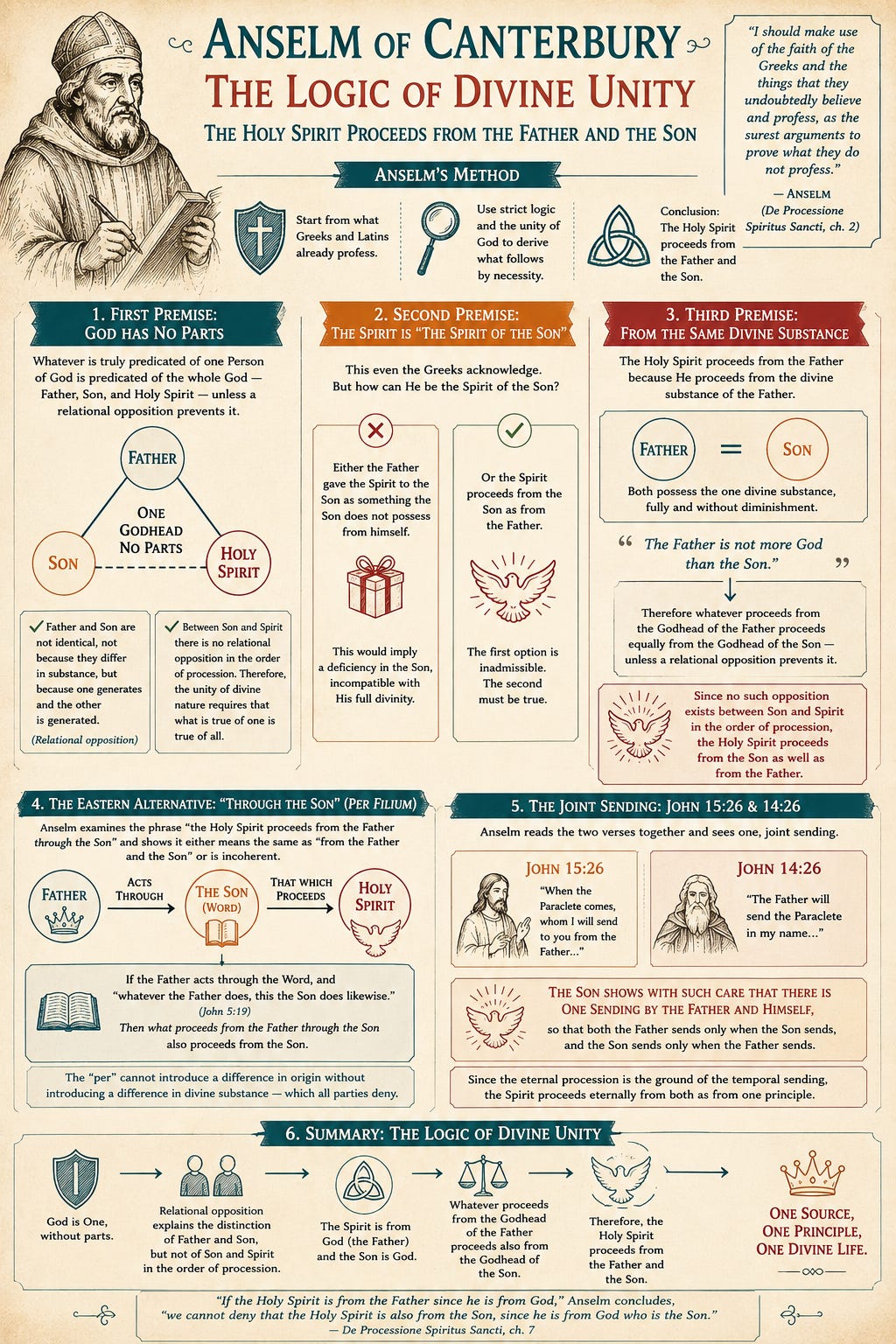
Anselm of Canterbury takes a boldly different route. Rather than analogy or metaphysics, he begins with what both Latins and Greeks already profess — and derives the Filioque from it by strict logical necessity. His opening move is strategic:
“I should make use of the faith of the Greeks and the things that they undoubtedly believe and profess, as the surest arguments to prove what they do not profess.”9
His first premise: God has no parts. Whatever is truly predicated of God is predicated of the whole God — Father, Son, and Holy Spirit — unless a relational opposition prevents it. Father and Son are not identical, not because they differ in substance, but because one generates and the other is generated — a relational opposition that prevents personal identity. But where no such relational opposition exists, the unity of the divine nature requires that what is true of one Person is true of all.
His second premise: the Holy Spirit is truly “the Spirit of the Son.” This even the Greeks acknowledge. But how can He be the Spirit of the Son? Either the Father gave the Spirit to the Son as something the Son does not possess from himself — which would imply a deficiency in the Son, incompatible with His full divinity — or the Spirit proceeds from the Son as from the Father. The first option is inadmissible. The second must be true.10
His third premise: His most powerful argument flows from divine simplicity: the Holy Spirit proceeds from the Father because He proceeds from the divine substance of the Father. But the Son possesses that same divine substance, fully and without diminishment.
“The Father is not more God than the Son.” Therefore whatever proceeds from the Godhead of the Father proceeds equally from the Godhead of the Son — unless a relational opposition prevents it. And no such opposition exists between Son and Spirit in the order of procession. “If the Holy Spirit is from the Father since he is from God,” Anselm concludes, “we cannot deny that the Holy Spirit is also from the Son, since he is from God who is the Son.” 11
Anselm also engages the Eastern alternative — the formula that the Spirit proceeds from the Father “through the Son” (per Filium) — and finds it either equivalent to the Latin position or incoherent. If the Father acts through the Word, and “whatever the Father does, this the Son does likewise” (John 5:19), then what proceeds from the Father through the Son also proceeds from the Son. The per cannot introduce a difference in origin without introducing a difference in divine substance — which all parties deny.
Anselm’s reading of John 15:26 and 14:26 in tandem is particularly elegant. When the Son says “whom I will send to you from the Father” and the Father says He will send the Spirit “in my name” — both express a single, joint sending. “The Son shows with such care that there is one sending by the Father and Himself, so that both the Father sends only when the Son sends, and the Son sends only when the Father sends.” 12 And since the eternal procession is the ground of the temporal sending, the Spirit proceeds eternally from both as from one principle.
VII. Three Roads, One Summit
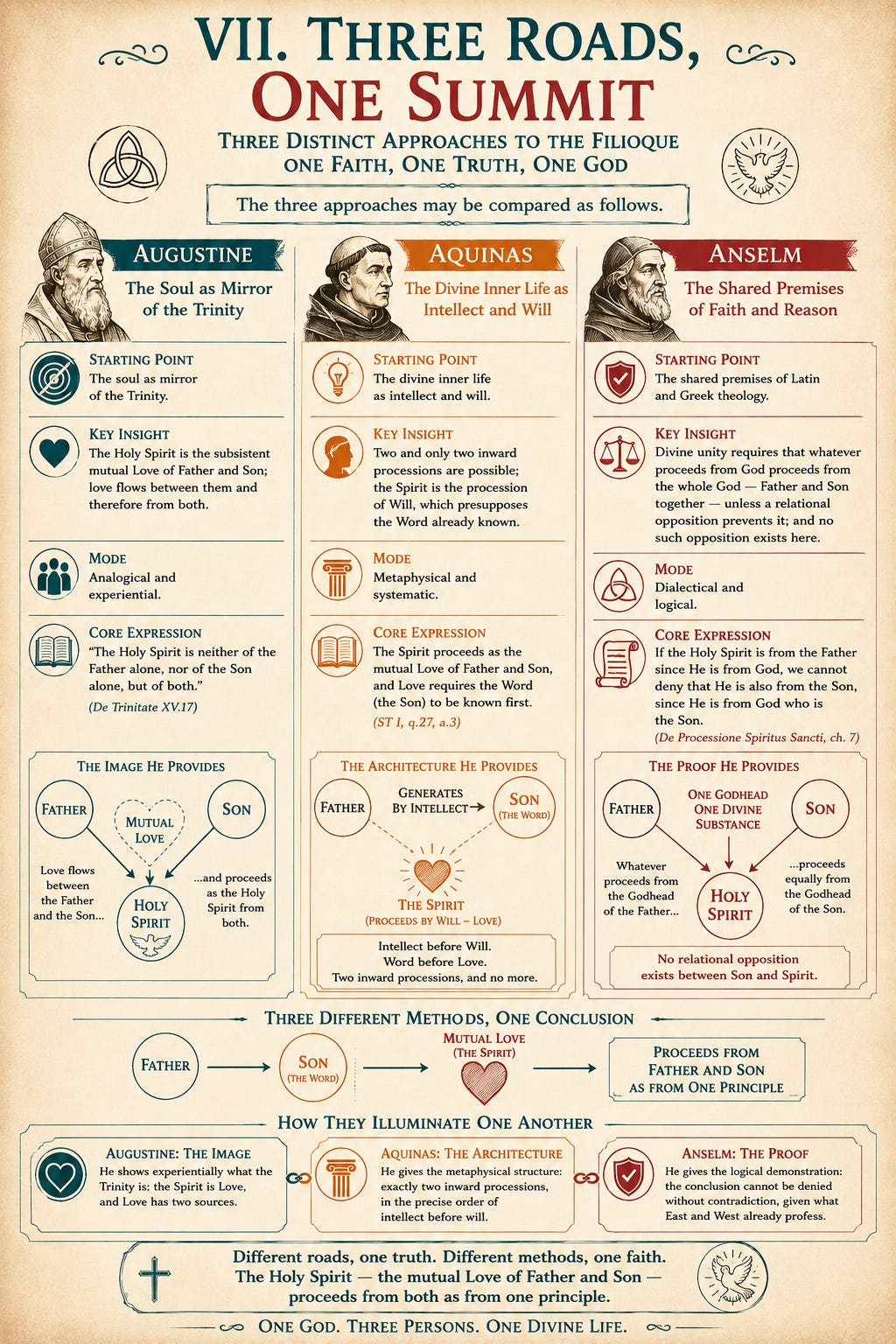
The three approaches may be compared as follows:
Augustine ~ Starting point: the soul as mirror of the Trinity. Key insight: the Holy Spirit is the subsistent mutual Love of Father and Son; love flows between them and therefore from both. Mode: analogical and experiential.
Aquinas ~ Starting point: the divine inner life as intellect and will. Key insight: two and only two inward processions are possible; the Spirit is the procession of Will, which presupposes the Word already known. Mode: metaphysical and systematic.
Anselm ~ Starting point: the shared premises of Latin and Greek theology. Key insight: divine unity requires that whatever proceeds from God proceeds from the whole God — Father and Son together — unless a relational opposition prevents it; and no such opposition exists here. Mode: dialectical and logical.
What is remarkable is that three such different methods arrive at the same conclusion — and that they illuminate one another in a precise way. Augustine provides the image: he shows experientially what the Spirit is — Love — and that Love by its very nature flows between a Lover and a Beloved, from both. Aquinas provides the architecture: the metaphysical structure of exactly two inward processions, in the precise and necessary order of intellect before will, Word before Love. Anselm provides the proof: the logical demonstration that the conclusion cannot be denied without contradiction, given what East and West already profess together. The image needs the architecture to explain why there are two processions and not more. The architecture needs the proof to show why the Son cannot be excluded from the second. And the proof, without the image and the architecture, would remain a logical skeleton without theological flesh.
VIII. Anselm and the Filioque in the Creed
Beyond the logical argument, Anselm also addresses the historical objection the Greeks pressed most pointedly: why did the Latin Church insert the Filioque into the Nicene-Constantinopolitan Creed without a general council?
Anselm does not evade the question. He meets it directly in the final chapters of De Processione Spiritus Sancti. 13
The Greek reproach was straightforward:
The Creed, as defined at Constantinople in 381, spoke only of the Spirit proceeding “from the Father.” The Latins had altered a text of conciliar authority without Eastern consent. Anselm acknowledges the fact of the addition but contests the characterization of it as a corruption.
His distinction is precise:
adding something contrary to the Creed would be corruption; adding something that follows necessarily from what the Creed already contains is clarification, not innovation. The doctrine of the Filioque, he argues, is a necessary consequence of what East and West already jointly confess — that the Son is fully God, and that the Spirit proceeds from God.
He reinforces this with what might be called the argument from parallel silences.
The Creed does not state that the Holy Spirit proceeds “from God” — yet both Latins and Greeks believe this without hesitation.
The Creed makes no mention of the Lord’s descent into hell — yet both sides profess it.
Silence in the Creed, Anselm observes, is not the same as absence from the faith. The Creed has never claimed to express the whole of what Christians must believe.
For the unilateral nature of the addition, Anselm offers four grounds.
First, pastoral necessity: without the explicit formula, those of simpler understanding might hesitate to believe what the faith already implied.
Second, logical necessity: the doctrine was not invented but recognized as already contained in the shared premises of Trinitarian faith.
Third, practical difficulty: assembling the Greek bishops for joint deliberation was not feasible.
Fourth, certainty of truth: the Latin Church, having no doubt about the doctrine, saw no need to submit it to debate as though it were an open question.
He is careful to add that the Latins continue to reverence the whole Creed as it stands in the Greek, and have set forth the Latin version with the addition as a clarification suited to ordinary speech and pastoral use — not as a replacement of the original.
The dispute over the addition itself proved as theologically charged as the underlying doctrine.
But Anselm’s core principle holds:
When a truth follows with logical necessity from what the whole Church already believes and professes, making that truth explicit in the liturgical formula is not a breach of conciliar authority but a faithful unfolding of what was already there.
VIII. The Glass Teaches Proportionately
Augustine returns at the close of De Trinitate to confess openly: he has labored long, he has seen much, but what he has seen is far less than what is there.
The procession of the Holy Spirit “will be understood more clearly when we are in bliss.” The glass is genuine; it is not yet the face-to-face vision.
To acknowledge this is not intellectual failure. It is theological honesty — and, in its own way, an act of worship.
Yet the glass has shown us something real and beautiful.
The Holy Spirit proceeds from the Father and the Son as from one principle, one spiration — not as from two separate sources, as if two rivers fed one sea, but as from one divine love that is simultaneously the Father’s love of the Son and the Son’s love of the Father. He is the eternal Bond of the Trinity, the subsistent Gift of mutual self-giving between Father and Son.
And this matters profoundly for how we receive Him. The Spirit who comes to us in Baptism, in the Eucharist, in prayer, in every act of charity — this Spirit is not merely a divine influence dispatched from on high. He is the Spirit of Christ, proceeding from the Son’s eternal Person, bearing the Son’s love into our hearts. He comes to reproduce in us the very love that constitutes the inner life of God.
“God sent forth the Spirit of His Son into our hearts, crying: Abba, Father” (Galatians 4:6).
The Filioque 14 is the dogmatic form of that cry. It tells us where the Spirit comes from, and therefore what He is bringing us toward: into the eternal love of Father and Son — the life of the Blessed Trinity itself.
“We see now through a glass in a dark manner; but then face to face.
Now I know in part; but then I shall know even as I am known.’”
Douay-Rheims 1 Corinthians 13:12
See article by Dr Oliver Tearle for more on quotations.
Endnotes
Spiration: A theological term derived from the concept of Spirit as used in Jn 3.8; Spiration is taken actively as the act of love and passively as the love proceeding, or the Holy Spirit. https://www.encyclopedia.com/religion/encyclopedias-almanacs-transcripts-and-maps/spiration
Dennis Ngien, “The Filioque Clause in the Teaching of Anselm of Canterbury — Part 2,” Churchman 118:3, citing Gerald Bray.
Raymond Taouk, “Filioque: Proceeds from the Father and the Son — The Scriptures and the Church Fathers,” Catholic Apologetics.
Augustine, Tractates on the Gospel of John, cited in Taouk, op. cit.
Augustine, De Trinitate, Book VII. The phrase echoes the Nicene Creed’s “Lumen de Lumine.”
Augustine, De Trinitate, Book XV, Ch. 17.
Thomas Aquinas, Summa Theologiae I, Q. 27, Art. 2, Respondeo.
Thomas Aquinas, Summa Theologiae I, Q. 27, Art. 3 (Respondeo, for the principle “nothing can be loved unless first known” and the procession of love); Art. 4 (for the distinction between generation and spiration, and why the Spirit is not called begotten).
Anselm of Canterbury, De Processione Spiritus Sancti, Ch. 1.
Anselm, De Processione, Ch. 12.
10. Anselm, De Processione, Ch. 2.
Anselm, De Processione, Ch. 4.
Anselm, De Processione Spiritus Sancti, Ch. 13 (his fullest treatment of the addition and the Greek objection)
Filioque the word inserted in the Western version of the Nicene Creed to assert the doctrine of the procession of the Holy Ghost from the Son as well as from the Father, which is not admitted by the Eastern Church. It was one of the central issues in the Great Schism of 1054.
Thank you for another wonderful lesson. This is perfect for the preparation of Pentecost. I have to read it slowly. Taking small bites. It’s very deep, but very beautiful and worth every moment to contemplate these truths.